
The Creative Voice
Connecting, reinventing, and stepping into the unknown

“The powerful play goes on and you may contribute a verse.” — Dead Poets Society
Welcome to my new subscribers. Thank you for joining me. This post has been percolating for a while. I’ve been musing on the elusive ‘voice’ in creative writing.
In her essay collection on writing, Negotiating with the Dead, Atwood presents a singular, transformative moment of her life as the key to making her into a writer:
Given such conditions, how is it that I became a writer? It wasn’t a likely thing for me to have done, nor was it something I chose, as you might choose to be a lawyer or a dentist. It simply happened, suddenly, in 1956, while I was crossing the football field on the way home from school. I wrote a poem in my head and then I wrote it down, and after that writing was the only thing I wanted to do. I didn’t know that this poem of mine wasn’t at all good, and if I had known, I probably wouldn’t have cared. It wasn’t the result but the experience that had hooked me; it was the electricity. My transition from not being a writer to being one was instantaneous, like the change from docile bank clerk to fanged monster in “B” movies. Anyone looking might have thought I’d been exposed to some chemical or cosmic ray of the kind that cause rats to become gigantic or men to become invisible.
“Orientation: Who Do You Think You Are?” Negotiating with the Dead: A Writer on Writing. (New York: Anchor Books, 2002).
She says, “It simply happened…I wrote a poem in my head and then I wrote it down”. Inspiration appeared and was acted upon. But is it that straightforward? Atwood’s voice here is so distinctive: the brilliant simile of the ‘B’ movie monster, reinforced by the image of “chemical or cosmic ray”, calling to mind her own speculative fiction and, even more powerfully, the message that she didn’t chose writing but it chose her. The iconic vision of a writer touched by inspiration, whether a muse, divine force or a cosmic ray, is easily recognisable and familiar, but is that the creative voice? Does it come from nowhere, touching some and not others?
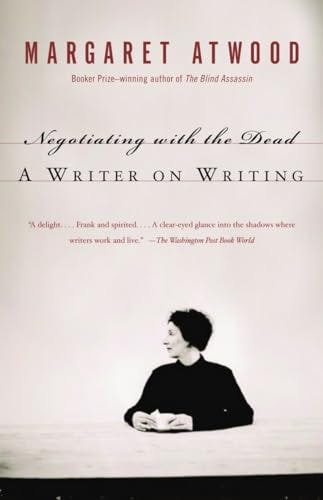
The collection of essays, continuously shot through with references to authors and books Atwood encounters on her writing journey, tells us that influence has as much part to play in the formation of her creative voice as inspiration. It may have started very suddenly, on a day like any other day, but to continue and to become a writer, Atwood engages cogently and astutely with writers from a huge range of genres and eras. In the title essay, Atwood comments on her reading as a young person from the Everyman’s Library series, going onto set the motto “Everyman I will go with thee and be thy guide” in its context from the medieval morality play in which the allegorical figure of Everyman is deserted by all his friends and guides, apart from Knowledge. If you are stripped down to the bare essentials of your spiritual life, your starting point for change must be knowledge. In her tour of the dead, Atwood goes on to consider Chekhov, The Odyssey, Hamlet, Tolkien, Adrienne Rich among others. She’s talking about how writers talk about death but in doing so she comments “All writers learn from the dead”. The past is reinvented in the writing present.
As Atwood testifies, writers are, of course, readers — avid, voracious, enchanted readers (possibly the type of reader who is now becoming increasingly rare). Most of my poetry engages in some way with other writers and texts, influenced by the wide range of writing I encounter as an English teacher. Playing around with voices and words from other writers inevitably raises questions about the borderlines between inspiration and derivation in the formation of a voice. Having spent so much of my writing life in the defensive posture of the academic, agonising over footnotes and looking over my shoulder to see whether citations are needed, I get nervous about whether I am doing enough to acknowledge sources and make the voices of others audible while not losing my own. When my poem “The Lament of Curley’s Wife” was published, the editor commented on how much he liked the voice. But the poem uses and reworks Steinbeck’s words for Curley’s Wife in Of Mice and Men to express her perspective in a reframing of the novel. So is it her voice or Steinbeck’s? Is it mine at all? At what point does inspiration shift into appropriation? When is it really our voice?

Back in January, I attended a conference in Cambridge on “Creative Medievalisms” Among recurring threads of conversations throughout the event was a ripple of ideas about voice — the human voice, the creative voice, our personal voice. Margery Kempe cropped up repeatedly in these discussions, as did the ventriloquized voice of Chaucer’s Wife of Bath. In “The Wife of Bath’s Prologue”, Chaucer lets the garrulous, “gat-toothed”, bawdy Wife speak at length, giving her free rein in the longest prologue of any pilgrim-teller in The Canterbury Tales. Veering between learned argument in which she takes on Church teaching on marriage and virginity and earthy vignettes of her life with her five husbands (“in his owene grece I made hym frye” she says acerbically of husband number four), the Wife is a lively, funny, engaging interlocutor. As she courts controversy she is interrupted within the Prologue by (male clerical) pilgrims who don’t like what she is saying or object to her going on for so long.
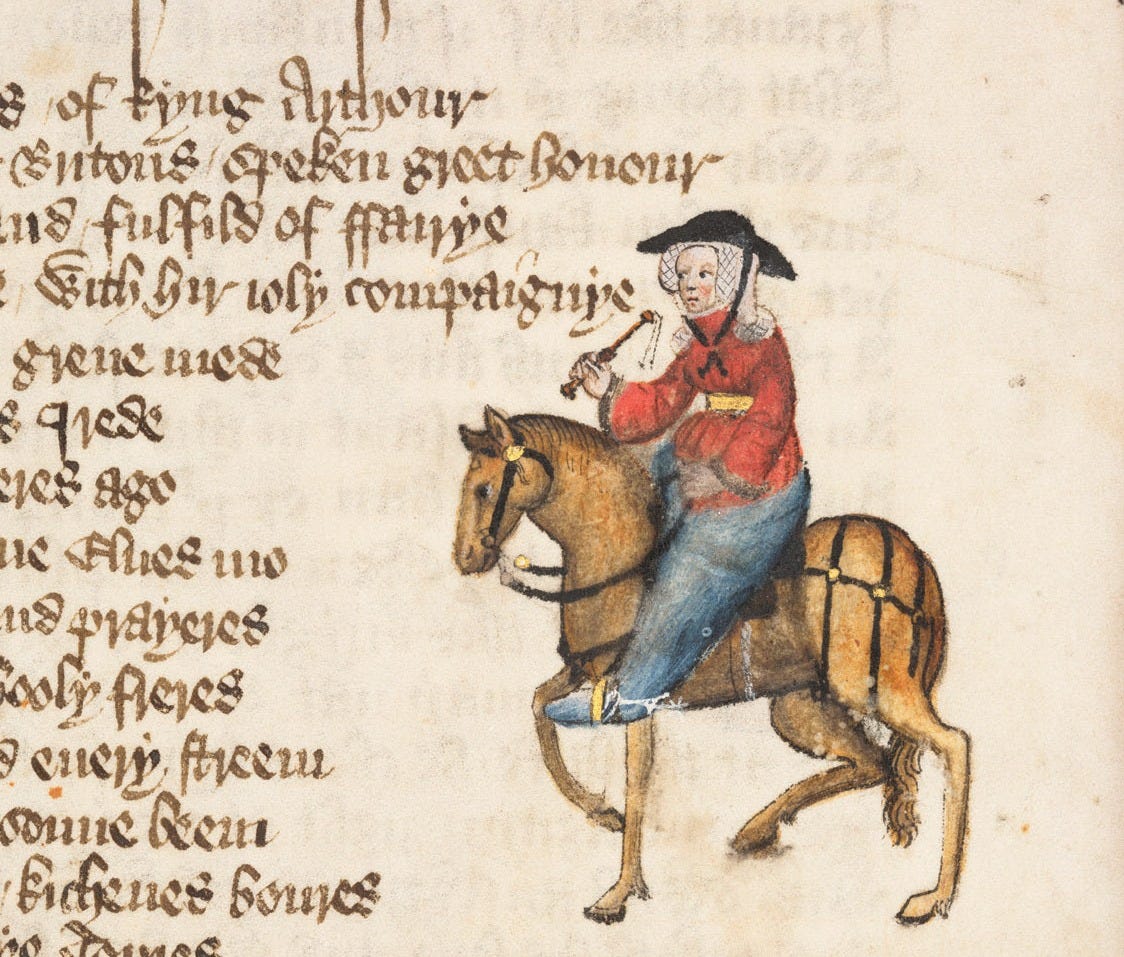
In fact, the Wife is such a distinctive character that, as Marion Turner observes, she is referred to by other speakers in The Canterbury Tales and emerges after Chaucer’s lifetime as a literary figure in her own right. She is even described by Thomas Hoccleve (1368-1426), a poet who knew Chaucer and promoted his reputation after his death, as a specifically female authority (auctrice) on the subject of women’s displeasure at men’s depiction of the female sex: “The wyf of Bathe, take I for auctrice” (“Dialogue”, 694). The Wife is the Chaucerian voice that escapes the bounds of the text and the control of its author to take on a life of her own.
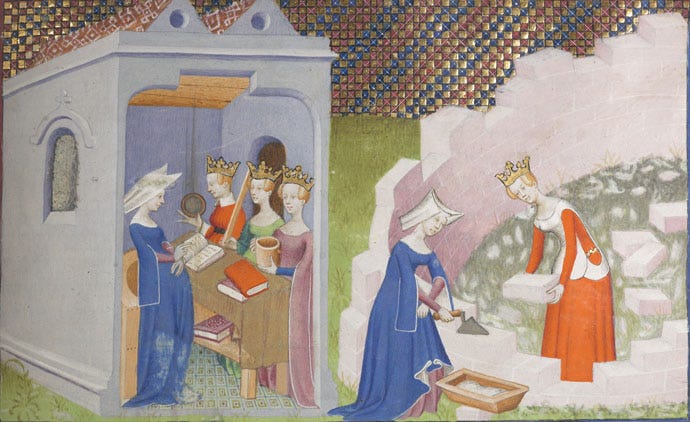
Yet despite her unique voice, Chaucer’s Wife is also in some ways utterly unoriginal, a creation based on the anti-feminist discourse of the time, sometimes viewed as nothing more than a collection of misogynist ideas brought to life. Chaucer was entering into a contemporary debate that was crowded with authorial opinions. Christine de Pizan’s The Book of the City of Ladies (1405) a catalogue of illustrious women is designed to respond to the anti-feminists. Although the style and form is very different, there is a common purpose with Chaucer’s Wife. Where Chaucer offers us the voice of an ordinary middle-aged woman with a wealth of experience of marriage, in The Book of the City of Ladies we encounter a dreamscape in which the Lady Reason, the Lady Rectitude and the Lady Justice explain to Christine that they will debunk all the misconceptions about women. Abounding in examples from history and myth, with a core of philosophy and a sharp critical eye for inconsistency, we can detect in Christine’s detailed rebuttal to the misogynists, something akin to the Wife’s vivacious and rather one-sided argument with the clerks. The subject matter overlaps, but the individual voices of the authors take the material in different directions.
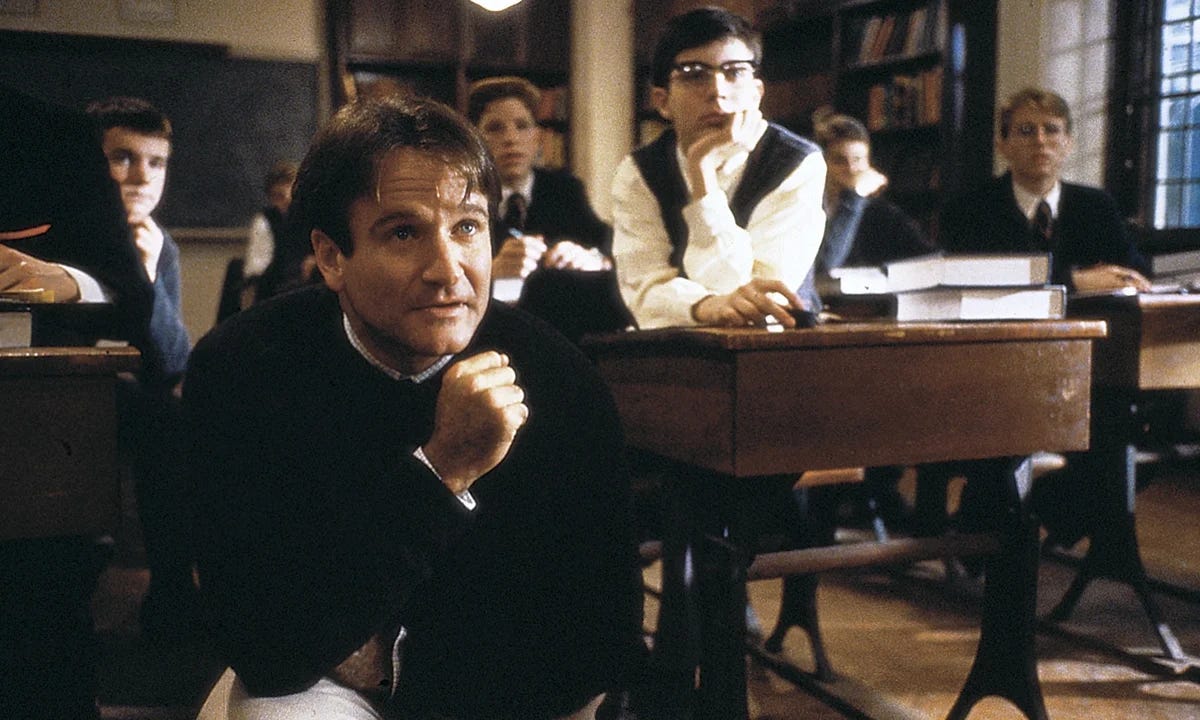
The creative voice then is the thin thread, the wisp of experience and meaning that the individual brings to the discourse, orchestrating the interplay between the living and the dead In the words of John Keating, the teacher played by Robin Williams in Dead Poets Society, it is the verse that we contribute to the play. Now, whenever we talk about voice, there is the unavoidable subtext of what it means to write in the age of AI when a pattern-recognition machine can spew out sense-making words. As someone who loves the struggle of writing and wrestling with words on the page, I cannot imagine why I would want my creative hand guided by a robot and I find it difficult to care about text that is not written by a human. It’s ersatz writing to me, no more than a poor substitute for the real thing. It removes the thin thread that makes the writing worthwhile for the author and meaningful for the reader.
I could inkwaste further on this topic, but I’ll let one of the medieval authors I’ve been contemplating have the last word: the voice of Reason in The Book of the City of Ladies. She tells Christine about a woman called “Carmentis” who (according to Reason) invented the Latin alphabet and therefore enabled knowledge to spread throughout Europe:
…it is thanks to her that men have been brought out of their ignorant state and become civilised…Thanks to her, men possess the art of encoding their thoughts and wishes into secret messages which they can send all over the world. They have the means to make their desires known and understood by others, and they have access to knowledge of the past and present events as well as to some aspects of the future… In short, it is impossible to count up all the advantages that the invention of the alphabet has brought: it is writing which allows us to describe and to know God’s will, to understand celestial matters, the sea, the earth, all individuals and all objects. I ask you then, was there ever a man who did more good than this?
Christine de Pizan, The Book of the City of Ladies, translated by Rosalind Brown-Grant, Part 1, Chapter 37 (Penguin Books, 1999)
When you think about writing like this, as both encoding and revealing, communicating and sharing, describing and understanding knowledge and ideas, its expressive power is infinite. Our creative voice too has infinite potential, infinite possibilities to connect with others. We shouldn’t squander it but allow it to step forward into the uncertainty of the next word, the next line, the next verse in this crazy play that we are writing which some of us call — life.
Further thoughts and recent reading
Amid the furore over the National Poetry Competition winner, I enjoyed the discussion of the purposes of poetry in “On the Poet as Maker” from Robert Charboneau, especially the commentary on Sir Philip Sidney’s “Defense of Poesy”.
Victoria Moul’s piece “Does it help to be religious” is thoughtful on the ways in which contemporary poets draw on religious tradition and are inspired by a depth of literary and linguistic meaning in the canon.
Apparently, the Middle Ages are now IN (as they should be).
Derek Thompson on “Everything is Television”.
Substacks which are a real joy at the moment: Lucy Mangan on books and Anna Neima’s art.
I read Naomi Klein’s Doppelganger: A Trip into the Mirror World and I would highly recommend it.
Such a super essay, and your voice is unmistakable! Even in The Lament of Curley’s Wife, it’s you, no matter where it all first came from, the act of (re)writing makes it yours.
This is a beautiful piece about the joy of writers reading. And thank you so much for my mention. I am very glad you have been enjoying my painting.